After twenty or thirty minutes of driving, your engine should be fully warmed up, and the temperature gauge should settle near its normal position. If the needle stays close to cold, barely moves, or drops while you are cruising, the engine may not be reaching the temperature it was designed to run at.
That does not create the same urgency as an overheating engine, but it still deserves attention. Engines that consistently run too cool can use more fuel, produce weak cabin heat, build up more moisture inside the oil, and sometimes turn on the check engine light. The key is figuring out whether the engine is actually cold or the gauge is simply giving you bad information.
A Thermostat Stuck Open Is the First Thing We Suspect
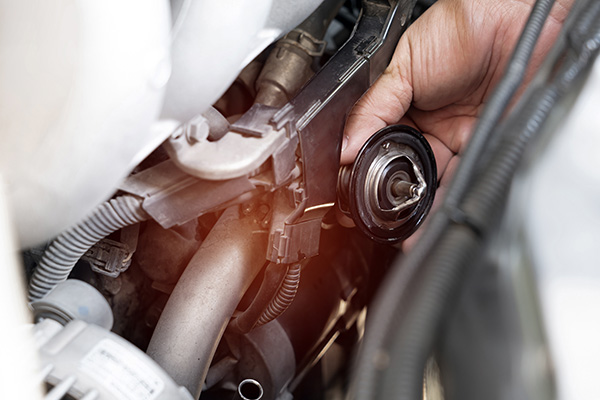
The thermostat blocks coolant flow to the radiator while the engine is warming up. Once the coolant reaches the correct temperature, the thermostat opens and allows heat to move through the radiator.
If it sticks open, coolant starts flowing through the radiator too soon. Highway driving can make the symptom even more noticeable because a steady stream of cool outside air is passing through the radiator. You might see the gauge rise a little in traffic and then drop again once you get back up to speed. That pattern is a strong clue that the thermostat is no longer regulating temperature correctly.
Your Heater May Tell You the Same Story
Cabin heat comes from hot engine coolant flowing through the heater core. If the engine never gets warm enough, the heater has less heat available to send into the passenger compartment.
A driver might complain that the heater works poorly on cold mornings, takes forever to warm up, or gets cooler during highway driving. When weak heat appears with a low temperature gauge, pay close attention to the actual coolant temperature. That combination points to a thermostat that allows too much coolant circulation before the engine reaches operating temperature.
The Coolant Temperature Sensor Could Be Reporting the Wrong Number
The gauge doesn't measure engine temperature on its own. A coolant temperature sensor sends information to the engine computer, which then uses it for the gauge, fuel control, cooling fan operation, and other functions, depending on the vehicle.
If the sensor or its wiring has a problem, the gauge can stay low even though the engine is fully warmed up. During an inspection, we compare the temperature the vehicle reports with the temperature we actually see at the engine. If the scan data says the coolant is unusually cold after a long drive, but the engine is clearly hot, the sensor circuit needs a closer look.
A Gauge or Instrument Cluster Problem Can Fool You
Sometimes the engine temperature is perfectly normal, and the problem is only what you see on the dashboard. A failing gauge motor, instrument cluster issue, poor electrical connection, or communication fault can keep the needle from moving to its normal position.
This is more likely when the heater works normally, fuel economy hasn't changed, and scan data shows the coolant reaches the proper operating temperature. We do not replace a thermostat just because the needle looks low. Verifying actual temperature first keeps a dashboard problem from turning into an unnecessary cooling-system repair.
Cooling Fans Running When They Shouldn't Can Keep Temperature Down
Electric radiator fans should turn on when the engine or A/C system needs extra airflow. If a relay sticks, a control problem develops, or the vehicle commands the fans incorrectly, they can run much longer than necessary.
A constantly running fan usually will not cool a healthy engine enough to overcome a properly closed thermostat, but it can make a weak thermostat problem much more obvious. If we hear the fans running hard shortly after a cold start or see them operating when the computer is not requesting them, we check the fan circuit along with the rest of the cooling system.
Why Running Too Cool Is Still Bad for the Engine
An engine is designed to spend most of its driving time within a specific temperature range. When it stays below that range, the computer can keep the fuel mixture richer for longer because it believes the engine is still warming up.
That can reduce fuel economy and increase deposits. Engine oil also takes longer to heat up enough to evaporate condensation and fuel vapors that collect during short trips. Regular maintenance becomes especially important when the vehicle is driven mostly around town because an engine that never warms fully already spends more time dealing with moisture and incomplete warm-up cycles.
Testing the Actual Temperature Gives Us the Answer
The quickest way to stop wondering is to compare what the gauge shows with what the engine is really doing. We look at coolant temperature data from a cold start, watch how quickly it rises, and see where it settles once the vehicle is driven.
A healthy thermostat produces a fairly predictable warm-up pattern. A stuck-open thermostat tends to warm slowly and can lose temperature during steady driving. A sensor problem can show readings that don't match the engine's actual temperature. Looking at the whole pattern gives us a much clearer answer than replacing the most common part and hoping it fixes the gauge.
Get Cooling System Service In Belmont, CA, With 5 Star Auto Service
If your temperature gauge stays low after a long drive, your heater takes too long to warm up, or the gauge drops while you are cruising, 5 Star Auto Service in Belmont, CA, can check the thermostat, coolant temperature sensor, fan operation, and actual engine temperature.
Schedule a cooling-system check to find out whether the engine is truly running too cold or the dashboard is simply reporting the wrong temperature.